

Top Hopper - Multiplication Game | 10story Learning

Multiply whole numbers

Roll dice, multiply and be the first to reach the Top Hopper trophy!
Top Hopper Game Setup
Grades
3-5
Game Length
20 minutes
Game Type
Hands-on, Competitive
  • Fluently multiply within 100. (3.OA.C.7)
  • Interpret products of whole numbers as the total number of objects in equal groups. (3.OA.A.1)
1

Inside the Math

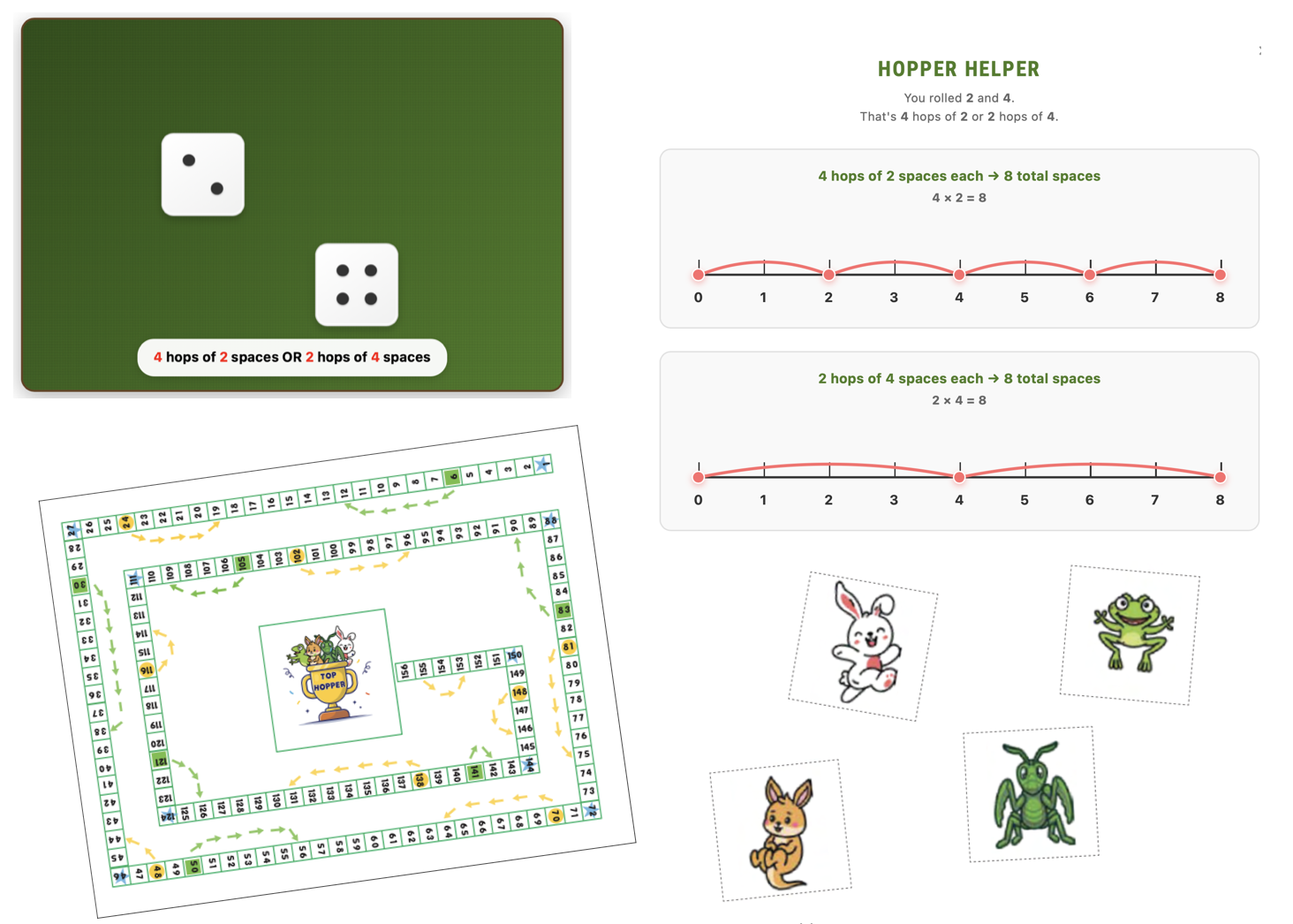
Each dice roll requires students to interpret two numbers as equal groups. When rolling 4 and 6, students choose whether to read this as "4 hops of 6 squares" or "6 hops of 4 squares"—both yielding 24 total squares, but requiring explicit recognition that multiplication can be read in either direction. This interpretive choice grounds multiplication in physical movement rather than abstract calculation.

The core mechanic develops translation between three representations: the dice showing two numbers, the verbal statement "X hops of Y squares," and the total distance moved. This translation process builds understanding that multiplication describes situations where equal groups are combined. A roll of 3 and 5 doesn't just mean "15"—it means three groups of five things, or five groups of three things.

The language structure "X hops of Y squares" provides consistent linguistic scaffolding for the equal groups meaning of multiplication

The word "of" signals multiplication in mathematical language. When students say "2 hops of 5 squares," they're describing a specific action: hop once to move 5 squares, then hop again to move another 5 squares. This verbal structure connects naturally to written notation: 2 groups of 5 becomes 2 × 5. Consistent use of this phrasing across all turns reinforces the linguistic-mathematical connection.

The Hopper Helper visualization represents multiplication as iterated groups along a number line. When students see their 2 hops of 5 displayed as two jumps from 0 to 5 to 10, they observe multiplication as repeated addition with visual support. The number line representation connects discrete groups (2 hops) to continuous quantity (10 squares total), bridging counting and measurement interpretations of multiplication.

Strategic thinking integrates calculation with spatial reasoning: Landing on green squares provides bonus forward movement, yellow circles force backward hops, and blue stars swap positions with opponents. Students calculate not just their product, but also where that result will land them and whether special squares affect their trajectory.

The commutativity of multiplication becomes practically relevant through player choice. A roll of 2 and 6 can be interpreted as either 2 × 6 or 6 × 2, both moving 12 squares. Through repeated gameplay where students choose this interpretation themselves and verify equality through board movement, they internalize that the order of factors doesn't change the product. This property emerges from experience rather than memorized rule.

Working with factors between 1 and 6 keeps calculations within manageable ranges while covering most single-digit multiplication facts. Students practice facts like 3 × 4, 5 × 6, and 2 × 4 in contexts where quick calculation provides competitive advantage. The structure motivates accuracy and efficiency without isolated drill—students want to calculate correctly to move strategically.

The 156-space board creates opportunities for students to work with larger products as they progress. Early spaces involve smaller movements (1 × 2, 2 × 3), but as students advance toward the trophy, they work with products like 5 × 6 = 30 or 4 × 6 = 24. This progression supports development from emerging fluency toward more automatic recall as gameplay continues.

The position-swapping mechanic introduces inverse thinking: "I need to move 17 squares—what multiplication facts yield 17?"

Blue star squares requiring position swaps introduce strategic calculation with specific targets. If an opponent is ahead, students might aim to land on a star square, requiring them to calculate which dice interpretation will result in landing exactly on that space. This inverse problem-solving—working backward from a desired product to identify possible factors—develops flexible thinking with multiplication relationships.

2

Building Foundation for Mathematical Thinking

The game develops multiplicative thinking—the ability to recognize and work with relationships involving equal groups. This differs from additive thinking, where quantities combine through accumulation. When students interpret "3 hops of 4" as multiplication rather than adding 4 three times, they're transitioning to multiplicative reasoning that underlies fractions, ratios, proportional relationships, and algebraic thinking.

The number line visualization connects multiplication to measurement and spatial reasoning. Students see multiplication not as abstract symbol manipulation but as movement along a continuous scale. This measurement interpretation supports later work with multiplying fractions, decimals, and variables—all of which can be understood as scaled distances or proportional relationships.

Skip counting emerges naturally: Students hopping "4 groups of 3" experience skip counting by threes four times. The board provides visual confirmation of skip counting patterns—landing on 3, 6, 9, 12 when making 4 hops of 3. This connects multiplication to number sequences and supports mental calculation strategies.

Strategic planning requires mental calculation and estimation before announcing moves. Students benefit from mentally calculating both options: "A roll of 4 and 5 could be 4 × 5 = 20 or 5 × 4 = 20. I'm on square 82, so either way I land on 102." This mental math practice builds number sense and calculation fluency in applied contexts rather than isolated exercises.

The competitive structure creates immediate feedback on calculation accuracy. Miscalculating 6 × 4 as 28 instead of 24 means landing four squares away from the intended position—potentially missing a beneficial green square or hitting an unfortunate yellow circle. This consequence makes precision matter in ways that worksheet problems often don't, motivating careful calculation.

Facts involving multiplicative identity emerge from gameplay: "1 hop of 6 squares" and "6 hops of 1 square" both demonstrate that order matters but product remains constant

Working with dice showing 1 through 6 means students encounter the full range of foundational multiplication facts. Facts involving 1 appear naturally: "1 hop of 6 squares" demonstrates that 1 × 6 = 6, while "6 hops of 1 square" shows 6 × 1 = 6. These experiences with multiplicative identity emerge from game situations rather than memorized rules, supporting conceptual understanding alongside procedural knowledge.

The game generates frequent encounters with multiplication by 2, 3, 4, and 5—facts that appear across mathematical contexts. Through repeated play, students develop automaticity with these core facts. The spatial-kinesthetic experience of "hopping" these groups supports memory formation through multiple modalities: verbal (announcing moves), visual (seeing board positions), and kinesthetic (moving pieces).

Position management introduces mathematical planning and factor identification. Students might think: "I'm on 95 and need to reach 105 to land on that green square. What dice rolls would get me there?" This requires identifying factors of 10 (2 × 5, 5 × 2) and considering probabilities. Such strategic thinking combines multiplication fluency with logical reasoning about constraints and possibilities.

Backward-movement penalties on yellow circles create situations requiring subtraction after multiplication—connecting operations within problem-solving contexts. Students calculate their product, move forward, then potentially move backward. This integrated arithmetic mirrors real-world contexts where multiple operations combine in sequence, supporting flexible operation sense.

3

In the Classroom

The game works well when students have been introduced to the equal groups interpretation of multiplication and are developing fluency with facts. It provides meaningful practice that connects conceptual understanding to procedural skill. Students should understand that multiplication describes combining equal groups before playing—the game reinforces and develops this understanding through application rather than introducing it from scratch.

For students still building multiplication concepts, beginning with the Hopper Helper tool ensures visual support for each calculation. The digital dice and helper combination allows students to verify their thinking: they announce their interpretation, calculate the result, move their piece, then check the helper to confirm. This verification loop supports accuracy while building confidence in mental calculation.

Material setup is straightforward: The game board, tokens for each player, and either physical dice or the digital dice with Hopper Helper. Games work well with 2-4 players or teams. Larger classes can run multiple simultaneous games, with students rotating after each game to play with different opponents.

Encouraging verbal articulation of moves supports mathematical communication development. When students must say aloud "4 hops of 5 squares" before moving, they practice using precise mathematical language. This verbalization also makes student thinking visible to teachers—listening to how students describe their moves reveals their understanding of multiplication structure and potential misconceptions.

Observing whether students pause to calculate, count on fingers, or respond immediately reveals their current level of multiplication fluency and guides instructional decisions

Teachers can observe multiplication fluency during gameplay without formal assessment. Students who quickly announce their interpretation and move confidently demonstrate automaticity with facts. Students who pause to count or use fingers show where additional practice may help. Students who confuse multiplication with addition reveal conceptual gaps requiring targeted support through explicit instruction or manipulative work.

Strategic elements provide built-in differentiation. Students still developing multiplication fluency focus primarily on accurate calculation. Students with stronger fact knowledge engage with board strategy—choosing dice interpretations to land on specific squares, planning routes to avoid yellow circles, timing star squares advantageously. This strategic layer keeps the game engaging for students across skill levels without requiring separate activities.

The game supports mathematical discourse when students explain their strategic thinking. After a game, discussing questions like "What dice roll did you hope for when you were on square 90?" or "Why did you choose 3 × 6 instead of 6 × 3 on that turn?" prompts students to articulate mathematical reasoning. These discussions reveal that even when products are equal, context may favor one interpretation over another.

Extensions for students needing additional challenge: Play with 2-12 sided dice for larger products, require players to predict exact landing position before rolling, or analyze which board positions are mathematically advantageous based on likely dice combinations and probability.

For students requiring additional multiplication support, several scaffolds work within the game structure: provide multiplication charts for reference, allow use of the Hopper Helper on every turn, start with smaller dice (1-4 instead of 1-6), or play cooperatively where teammates verify each other's calculations. These modifications maintain engagement while providing necessary support for skill development.

The game lends itself to tournament formats where students track wins and analyze progress over multiple games. Students can examine whether their speed and accuracy improve across games, connecting gameplay to learning growth. Keeping a class "Top Hoppers" leaderboard motivates continued engagement while celebrating multiplication fluency development in visible, celebratory ways.

Using gameplay as formative assessment reveals not just whether students know their facts, but how fluently and flexibly they apply multiplication in context

The game format creates variety in how students encounter multiplication facts compared to worksheets or flashcards. The physical movement around the board, competitive element, and strategic decision-making engage different cognitive and motivational systems than traditional drill. This variation supports learning by providing multiple entry points and maintaining engagement over repeated practice sessions.

Teachers can use gameplay observations to guide decisions about which facts need additional focused practice. Noting which multiplication facts students calculate quickly versus which require more time or support helps target instruction efficiently. The game reveals patterns in student understanding—for example, whether difficulty is concentrated around specific factors (like 6s and 7s) or reflects broader conceptual gaps.

After students become familiar with basic gameplay, introducing strategic elements more explicitly enriches mathematical thinking. Discussing optimal strategies, analyzing board patterns, or calculating probabilities of various dice combinations extends the mathematical value beyond multiplication practice alone. These extensions connect multiplication to broader mathematical reasoning including probability, strategic planning, and combinatorial thinking.

Students learn to check their work through peer verification and self-monitoring, ask for help when uncertain about calculations, and persist through challenges as they work toward the trophy. The activity drives the mathematics.