

Students often memorize factor pairs (4×6=24, 3×8=24) without developing systematic strategies for finding all factors of a number. Hive Factor gives them a reason to care about complete factorization: each factor they find lets them shade another hexagon on the path to safety. Miss a factor, miss a hexagon.
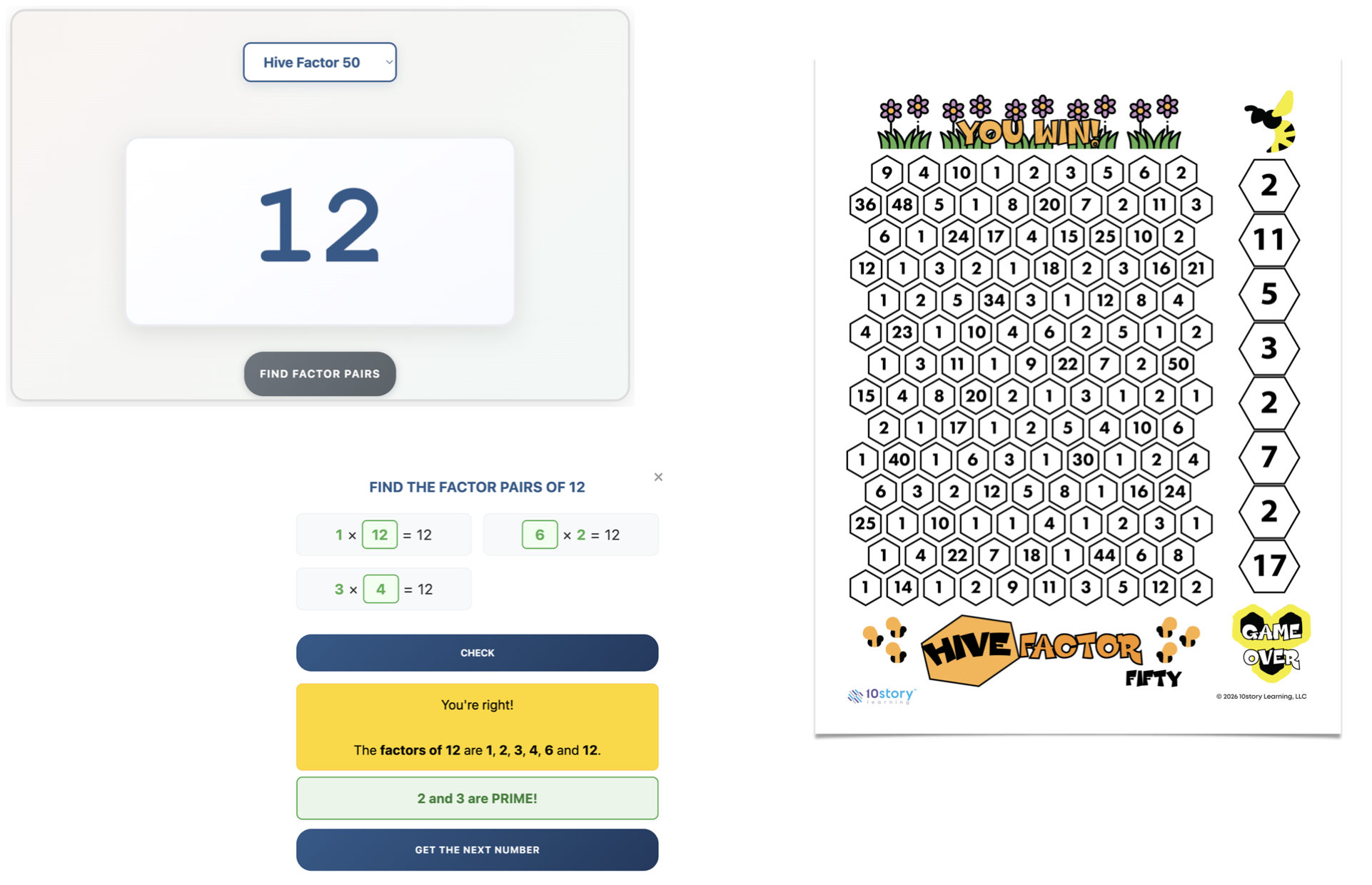
The basic loop is straightforward. Generate a number (say, 24). Find all its factors: 1, 2, 3, 4, 6, 8, 12, 24. Shade one hexagon for each factor. If any factors are prime, shade one hexagon on the wasp's path. Generate the next number and repeat. The bees win if their path reaches the edge before the wasp path fills completely.
The factor pair structure becomes visible through repeated play. When students find that 4 divides 24, they get 6 as a quotient—both are factors. This pairing (except for perfect squares) suggests a search strategy: test divisors up to the square root and you've found everything. The digital generator's "Find Factor Pairs" button makes this structure explicit when students need support.
The wasp mechanic does something pedagogically useful: it makes prime numbers matter in a new way. Students already know that primes have exactly two factors (1 and themselves). Now they discover that primes are common factors of composite numbers—every time 2 or 3 appears as a factor, the wasp advances. This creates an interesting tension: you want numbers with many factors (like 36 or 48), but those numbers inevitably contain prime factors.
The game distinguishes prime recognition from factorization skill: Finding that 47 is prime is quick—it's only divisible by 1 and 47—but advances the wasp with minimal path progress. Finding all twelve factors of 72 takes work but moves the bees significantly forward. Students start to recognize which numbers are "friendly" for path-building.
Two versions scaffold difficulty by number range. Hive Factor 50 keeps numbers below 50, where multiplication facts are more familiar and factorization patterns are more transparent. Most numbers have relatively few factors—24 has eight, 30 has eight, 36 has nine. Students build automaticity with divisibility by 2, 3, 5, and learn to check systematically.
Hive Factor 100 introduces larger numbers where factorization requires more organization. Numbers like 72 and 96 each have twelve factors, requiring students to track which divisors they've tested and which factor pairs they've found. The larger range also means more primes (41, 43, 47, 53, 59, 61, 67, 71, 73, 79, 83, 89, 97), increasing the probability of wasp advancement.
The hexagonal board makes factorization progress visible. Small numbers like 2 and 3 appear on dozens of hexagons because they're factors of many numbers. Larger primes like 23 and 47 appear rarely. Students can see which numbers are mathematically "common" by how quickly their hexagons fill. This spatial representation helps students build intuition about factor frequency and number structure.
Cooperative play creates natural opportunities for checking work. When one student says "6 is a factor," another can verify: "Does 24÷6 work? Yes, it's 4." Disagreements get resolved through calculation rather than authority. The shared goal—getting the bees out before the wasp arrives—motivates this collaborative verification without making mistakes feel high-stakes.