Race motorized cars.
Discover slope.
Students build a Gravity Racer, collect distance and time data from real ramp runs, and write linear equations from their own measurements.

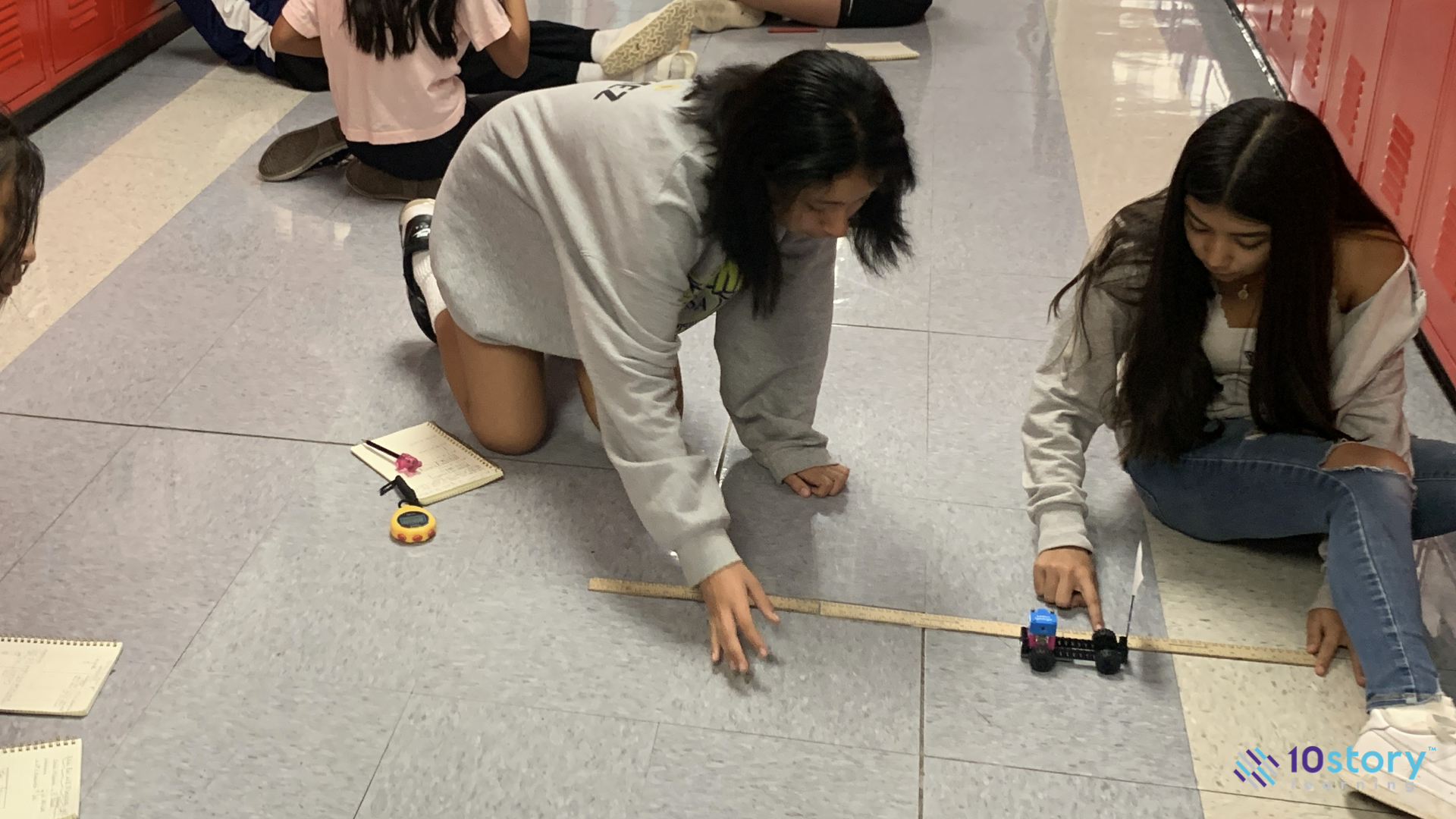
Algebra Studio: Slope Lab is an 11-lesson, 12–15 hour hands-on Math Lab. Students build a Gravity Racer using Circuit Cubes™ kits, roll it down ramps, collect real distance and time data, and make graphs. Then they build a Motor Racer — a vehicle that moves at a fixed rate. Using their data, students work through challenges involving rate, slope, and linear equations.
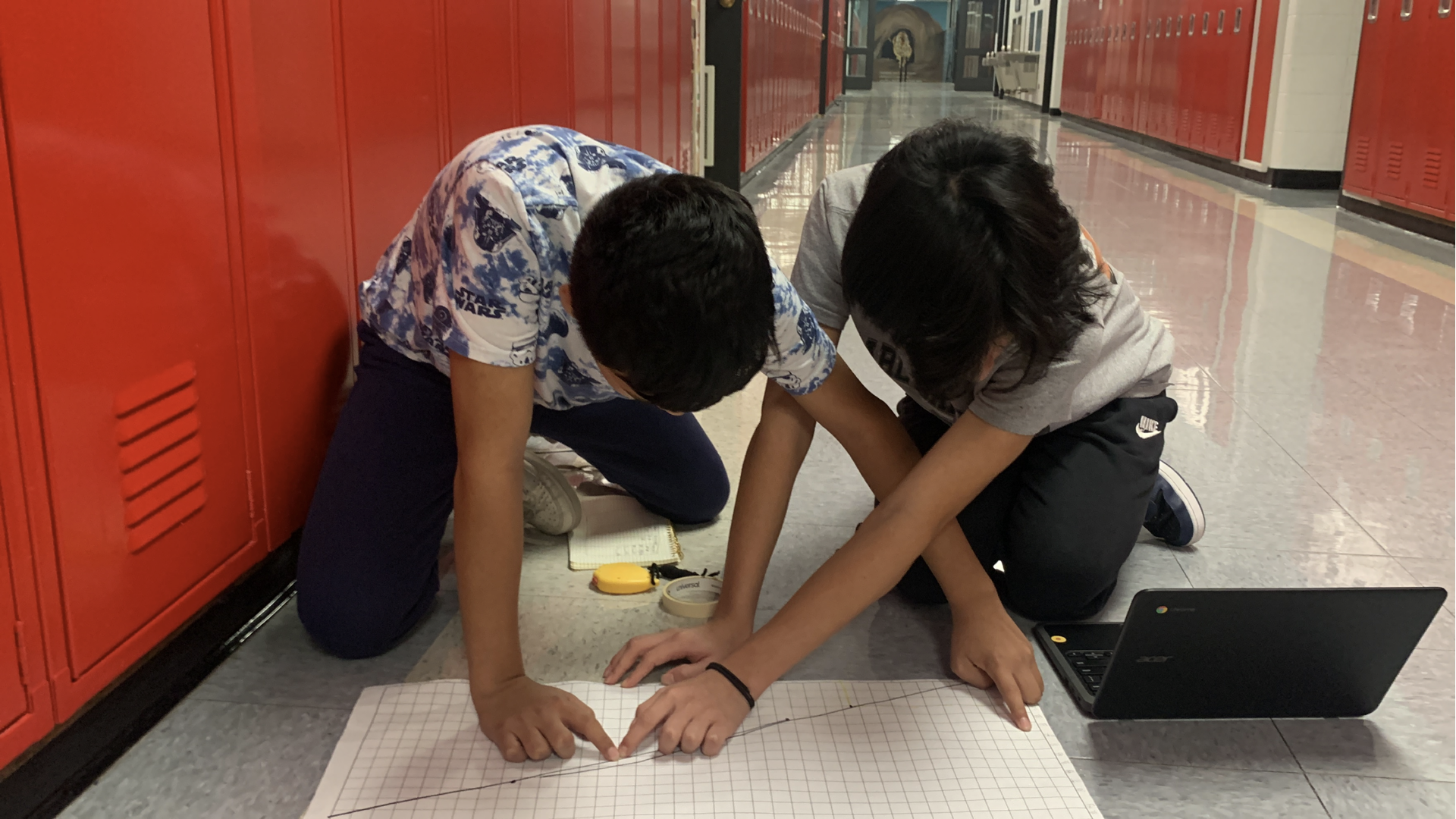
Students start by measuring and recording — physical data from physical ramps. They organize their data into tables, plot it on coordinate grids, and look for patterns. From there, they calculate unit rate, identify slope in their own graphs, and write equations in y = mx + b form. The progression moves from collecting data with meter sticks and stopwatches, to representing it on graphs, to writing equations that model what they measured.
How the curriculum works
Students assemble a Gravity Racer, then progress through data collection, graphing, slope, and linear equations — ending with a Grand Prix finale.
- Lesson 1 — Gravity Racer: Students build a Gravity Racer from Circuit Cubes™ parts, run time trials down ramps, and notice how the racer moves.
- Lesson 2 — Gravity Racer Graph: Students plot their time and distance data, read the shape of the line, and notice how the racer's motion changed.
- Lesson 3 — Movement Stories: Students see motion on a variety of graphs and match motion stories to the graphs that describe them.
- Lesson 4 — The Motor Racer: Students build a Motor Racer that moves at a steady rate, explore how it moves, and collect and graph its data.
- Lesson 5 — Making Predictions: Students use their data to make predictions, then test their accuracy with prediction trials.
- Lesson 6 — Hit the Target: Students find their racer's unit rate in meters per second and use it to make predictions and play Hit the Target.
- Lesson 7 — Slope: Students connect unit rate to steepness, calculate slope from two points, and change their racer's gears to change the rate.
- Lesson 8 — Slope Equations: Students write their racer's motion as an equation in y = mx form and use it to predict and compare without a table or graph.
- Lesson 9 — Head Start: Students change the starting point of their racer, collect and graph new data, and write a new kind of equation in y = mx + b form.
- Lesson 10 — Photo Finish: Students calculate a head start using graphs and equations, then race their cars to a photo finish.
- Lesson 11 — Grand Prix: Students design a Grand Prix racer and use its rate and head start to race for the Championship.
11 lessons at a glance
Three sample lessons
Who it's for
- 7th–8th grade teachers looking for a hands-on supplement in rate, slope, and linear equations.
- 9th grade teachers who need Algebra 1 foundations support.
- Afterschool and summer program directors who want structured, ready-to-run STEM programming with all materials included.
- Curriculum coordinators looking for standards-aligned supplements that work alongside any core curriculum — no adoption process required.
What's in the kit
- Circuit Cubes™ kits (Gravity Racer + Motor Racer)
- Ramp kits with adjustable heights
- Meter sticks and stopwatches
- Graphing sheets and data recording forms
- Gear investigation materials
- Grand Prix competition materials
- Equation worksheets and prediction sheets
- Quick-reference teacher booklet
How it runs in the classroom
Every lesson runs through a web-based slide portal at algebrastudio.org. Each lesson opens with the day's task and team setup, then moves into the hands-on activity at the ramps. Short visual mini-lessons teach the math students need to do the work, narrated by veteran math educator Howie Templer.
Lessons run about 60 minutes, with some running longer at the teacher's discretion. The curriculum works as a daily block (about 3 weeks), a twice-weekly enrichment (5–6 weeks), or an afterschool/summer program. It supplements any core curriculum — students learn rate, slope, and linear equations through their regular instruction, and Algebra Studio: Slope Lab is where they apply those concepts with physical materials and collaborative problem-solving.
Open the kit, follow the slides, and go.
Standards by lesson
Algebra Studio: Slope Lab covers measurement, rate, unit rate, proportional relationships, slope, and linear equations — standards spanning grades 6–8, with extensions into Algebra 1. It doesn't replace your core instruction on these topics. It gives students a place to apply what you're already teaching, using physical materials and collaborative problem-solving.
| # | What students do | Standards |
|---|---|---|
| 1 | Gravity Racer — build, run trials & collect motion data | 6.SP.A.3 |
| 2 | Gravity Racer Graph — plot data, read the line | 6.SP.A.3, 6.EE.C.9 |
| 3 | Movement Stories — match motion to its graph | 8.F.B.5 |
| 4 | The Motor Racer — constant rate & proportional data | 8.EE.B.5 |
| 5 | Making Predictions — reason from the data | 8.F.B.4 |
| 6 | Hit the Target — compute & interpret unit rate | 6.RP.A.3b |
| 7 | Slope — rise over run & rate of change (gears) | 8.EE.B.5 |
| 8 | Slope Equations — write motion as y = mx | 7.RP.A.2c |
| 9 | Head Start — write y = mx + b | 8.F.A.3 |
| 10 | Photo Finish — compare lines & engineer a tie | 8.EE.C.8 |
| 11 | Grand Prix — race using rate & head start | 8.F.B.4 |
Professional development
PD is optional. The teaching portal provides step-by-step guidance for every lesson, and most teachers run Algebra Studio: Slope Lab successfully from the slides alone. PD is recommended when you want to deepen teaching practice around hands-on facilitation, or when a department or grade-level team is adopting the lab together.
Professional development for Algebra Studio focuses on teaching practice — structuring hands-on learning, facilitating collaborative problem-solving, and reading student thinking during data collection and graphing work. Led by a nationally recognized math educator, teachers work through a Slope Lab session as learners — building the racer, running ramp trials, collecting data, plotting graphs, and writing equations from their own measurements. Then they unpack the teaching moves with the facilitator: how to structure the teamwork, where students get stuck, what questions to ask, when to step back.
Format & details
- Half-day workshop, up to 30 participants
- Led by a nationally recognized math educator
- Teachers experience a full lab session as learners, then unpack the pedagogy
- Fundable through Title II-A professional development funds
- Available as a follow-up coaching package for ongoing implementation support
Evaluation partnership
For districts running formal evaluation studies. If your research office, grant funder, or district evaluation requirements call for a structured study of program impact, we partner with you to design one. If you're a classroom teacher, you don't need any of this to run Algebra Studio: Slope Lab — this section is for evaluation directors, research partners, and grant compliance.
Structure a rigorous study using your own assessments, your own comparison groups, and your own timeline. We don't sell the data — your district owns the results and is free to publish.
Research design options
Simple pre/post
Administer a brief assessment before and after the lab, using district benchmark questions or the Algebra Studio pre/post instrument.
Delayed-start RCT
Half of participating classrooms begin first, the other half a few weeks later. Assess all students after the first group completes the project. Use an Algebra Studio pre/post or your own assessment.
Matched comparison
Compare participating classrooms to non-participating classrooms with similar demographics and prior achievement.
Implementation + perception study
Document implementation fidelity, student engagement, and teacher perception alongside quantitative measures.
Kit
The Full Kit serves a single classroom of up to 28 students working in teams.
Full Kit
Materials for a full classroom running Algebra Studio: Slope Lab.
- Circuit Cubes™ Gravity Racer kits (motorless + Motor Racer)
- Ramp kits with adjustable heights
- Meter sticks and stopwatches
- Teacher portal access and all printables
Year over year
All Slope Lab materials are fully durable — the Circuit Cubes™ racer kits, ramp kits, meter sticks, stopwatches, and gear investigation materials. Buy once, use every year. Year 2+ cost: $0. The few consumable items (data sheets, graphing paper, prediction sheets) are available as printable PDFs through the teacher portal.
Funding
Schools and districts commonly fund Algebra Studio: Slope Lab through:
- Title I (supplemental support for under-served students)
- Title IV-A (Student Support and Academic Enrichment)
- ESSER carryovers, where still available
- 21st Century Community Learning Centers (afterschool and summer)
- Foundation STEM grants
- PTO/PTA budgets for classroom enrichment
Quantity discounts are available for multi-classroom orders. Ask us for a quote.